
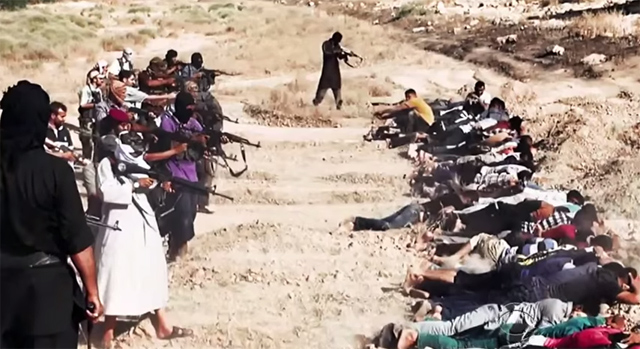
A decade ago, hundreds of Westerners streamed out of London, Birmingham, Manchester, Minneapolis, and Columbus to join the Islamic State. They weren’t merely curious spectators of a dark movement; they were converts to a brutal faith of fire. They thrilled at ISIS videos of men burned alive in cages, heads severed on sand, and ancient cities razed under the banner of the Caliphate. Entire families—women and children included—picked up and moved to Syria and Iraq to participate in the dream of a world purged of infidels. Many never returned.
Today they don’t need to leave home.
The same ideological impulse that carried them to Raqqa now drives attacks on local Jews down the street—in schools, synagogues, coffee shops, and commuter trains. Radical jihadism has simply switched labels: from “ISIS” to “Palestine,” from “Caliphate” to “Resistance,” from overt barbarism to the socially-acceptable pose of “solidarity.” The mission is unchanged. Only the hashtags are new.
And while Western governments once scrambled to stop teenagers from boarding flights to Turkey, today they barely raise an eyebrow as mobs chant for Jewish death on college campuses and in city plazas. Police departments treat the threat as “protected speech” until someone lights the match or pulls the trigger. Surveillance of Jews hems closer, but nothing stops the expanding radical ranks of those who have found a new, easier battlefield: Western cities themselves.
The goal remains constant—burn down the old society and replace it with the black-green flag of radical Islam. In the Middle East, ISIS tried to seize territory. In the West, its ideological descendants aim to seize the streets, the discourse, and the public square.
The West fought—haltingly—to slow ISIS’s spread in Iraq and Syria. But it is utterly unprepared to confront the same doctrine as it metastasizes in Africa, online, and now in its own neighborhoods. European governments write reports; American politicians hold hearings; academics write tortured essays parsing the “legitimate grievances” of those calling for slaughter.
Only one country behaves as if the threat is real. Israel fights it directly, understanding the battle as existential rather than theoretical. Israelis have seen what happens when radical jihadists gather strength: they massacre civilians, rape women, burn communities, and boast about it online.
But the West still imagines that it can appease the ideology, contain it, or reinterpret it as a civil-rights movement. In certain cities, it is preparing to forfeit its Jews first—sacrificing them to buy temporary calm—while missing the larger reality that the same forces aiming at Jews today aim at the entire Western democratic structure tomorrow.
Societies do not collapse in a single moment. They erode from below, from the foundations. And those foundations—rule of law, minority protection, civic trust, freedom of worship, the very idea of objective truth—are already cracking as the zealots find new targets and new excuses.
The West destroyed the physical caliphate. It never touched the ideological one, the one which drew warriors from its own streets.
Now the jihad is local.

 First One Through