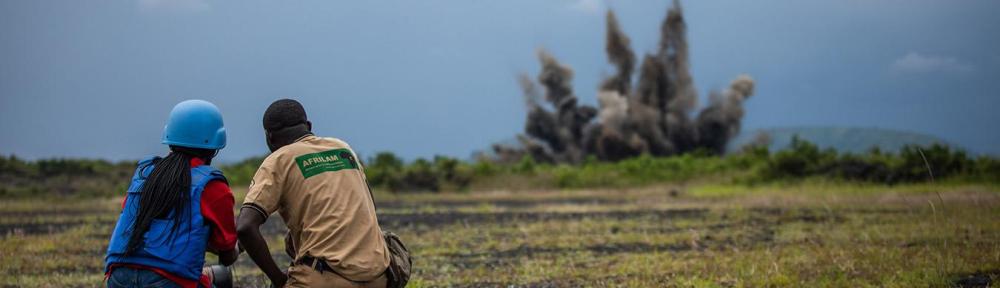
Every year, the United Nations marks the International Day for Mine Awareness and Assistance in Mine Action, a day meant to focus the world on one of war’s most enduring dangers: explosives that linger long after the fighting ends. It is supposed to be about clarity, about identifying risks so civilians can return home safely.
Instead, it has become a case study in how language can blur reality.
The Secretary-General’s message follows a familiar script. Landmines, explosive remnants of war, improvised explosive devices—all grouped into a single, undifferentiated threat facing millions. Then comes the quiet insertion: Gaza. Not explained, not distinguished, simply placed alongside countries like Colombia, Ethiopia, Lebanon, Myanmar, and Syria—places long associated with entrenched landmine contamination. With that single move, a narrative is constructed without ever being explicitly stated.
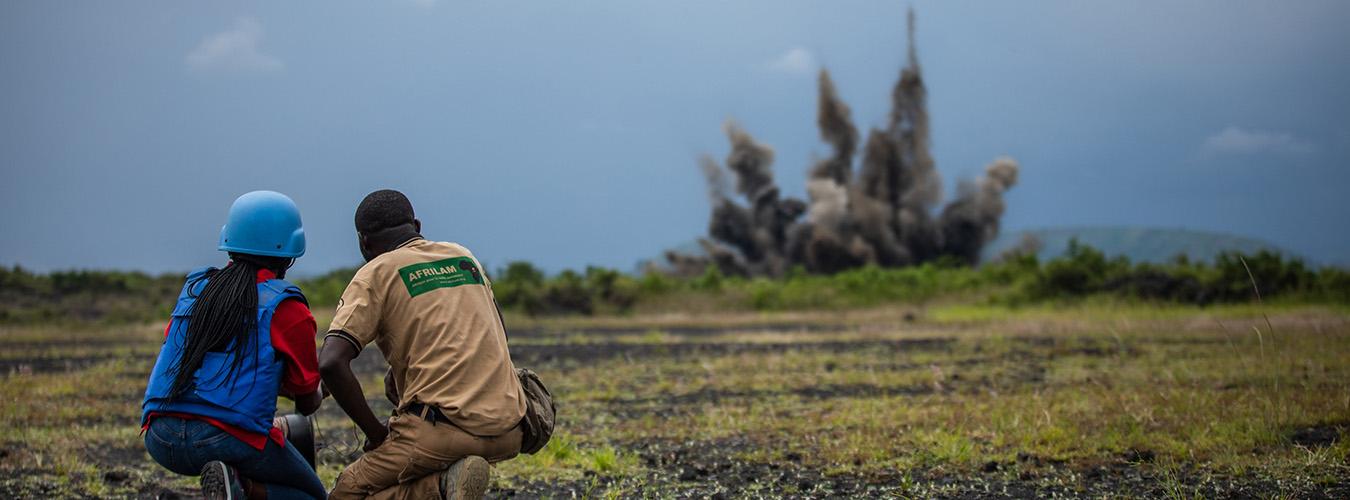
The problem begins with the collapse of categories. Landmines, IEDs, and explosive remnants are not interchangeable. Landmines are deliberately planted, often victim-activated and designed to persist. IEDs are improvised weapons, most commonly used by non-state actors. Explosive remnants of war are what’s left behind—unexploded bombs, artillery shells, rockets. In Gaza, those distinctions are not academic; they are the entire story.
Hamas and other Palestinian militant groups have relied heavily on IEDs and booby traps as a core tactic. Not Israel. There does remain unexploded ordnance buried in rubble after extensive Israeli strikes. But the UN language compresses all three categories into one phrase and drops Gaza into the middle of it, allowing implication to do what evidence does not.
Just as telling is the disappearance of agency. The United Nations Mine Action Service and related reporting have acknowledged encountering IEDs in Gaza. But in public-facing messaging, the actor behind those devices vanishes. There is no mention of Hamas, the governing authority in Gaza that initiated this war with the October 7 attacks. There is no mention of homes rigged with explosives, of tunnels wired for ambush, of civilian infrastructure turned into tactical hazards. The war did not emerge from nowhere; it was launched by Gaza’s rulers, and Israel did not seek it. Yet in the UN’s framing, explosives simply exist, detached from the decisions and strategies that put them there. When agency disappears, accountability follows.
The rhetorical effect is powerful. By placing Gaza alongside countries defined by decades of landmine contamination, the UN shifts perception. Gaza becomes, in the public mind, a classic minefield. But it is not. It is a dense urban battlefield littered with booby traps and complicated by the deliberate use of improvised explosives by militant groups embedded within civilian areas.
The reality is that Gaza is a public hazard of itself. The mines, the terror tunnels under homes and schools, the embedded terrorists throughout neighborhoods is a tragedy the UN helped foster.
Rather than take a modicum of responsibility or lay blame on its adopted wards, the UN’s language pivots the blame on the victims of October 7. It deliberately has tried to change history and public perception that Israel deliberately turned Hamas into a large minefield when Gazans did that to themselves.
The International Day for Mine Awareness was created to expose hidden dangers, to name them clearly so they can be removed. Here, the danger is not only in the ground. It is in the language. When distinctions collapse and responsibility dissolves, understanding becomes another casualty. And in a conflict already defined by competing narratives, what remains unexploded in the words can be just as damaging as what lies beneath the rubble.

 First One Through