We have reviewed the terrible anti-Israel bias ingrained in public schools in Talking About Local School Boards in New York State, and socialists’ activist influence in public school unions and school boards in Anti-Israel Socialists Are Coming For School Boards. This article will discuss a particular school district – White Plains, NY – as a basis for you to get involved in your own district, and will compare it to New Rochelle, a similar district nearby.
Basic Statistics
Start by understanding some key statistics about the school district before wading into the school board itself.
Greatschools.org is a good place to familiarize yourself with your school district. White Plains has seven schools: 5 elementary, 1 middle school and 1 high school. In their assessmnet, compared to New York State, 57% are performing below average and 43% are average, a pretty terrible score.
Digging into the data deeper, provides some understanding of the poor scores.
The student body of 6,887 is 58% Hispanic, 21% White, 10% Black, 4% biracial and 3% Asian. Roughly 17% are learning English and 50% are from low income households. The demographics are similar to New Rochelle which is a bigger school, with a greater percentage of Blacks students. White Plains has more students learning English (17% to 12%), while New Rochelle has a slightly greater percentage of students from low income households (55% to 50%).

While all of the racial groups perform well on U.S. history tests, the Hispanic and Black students perform below New York State average in English (30% and 29%), and Black students grossly underform in science (16% with proficiency), even compared to those same ethnic groups around the state. Curiously, each group performs well on standardized regents exams, making one wonder whether teachers are simply teaching to pass the regents rather than basic skills.
The dynamics are not unusual for the state. According to the GreatSchools site, Black students typically only have 22% average proficiency in science around the state, and Hispanics are at 23%. White and Asian students are at 43% and 55%, respectively, considerably higher. However, in White Plains, only Black students trail the state average.
The scores for Black students in New Rochelle in English were significantly better, with 43% being proficient, significantly higher than White Plains Black student body at 29%.
The figures in Ballotopedia are different, but also show that White Plains’ Hispanic and Black students do not cross 45% proficiency in Math, while White and Asian students have 73% and 75% proficiency, respectively. New Rochelle Hispanic and Black students each have 57% proficiency in Math, considerably higher than White Plains.
White Plains (WP) far exceeded New Rochelle (NR) and state averages in other categories like graduation rates (91% versus 83% and 87%, respectively for NR and state averages) and those taking Advanced Placement courses (AP), with 29% compared to 18% and 21% for NR and the state, respectively. Overall, 79% of White Plains’ graduating students went on either to college or vocational school, compared to 75% and 68%, respectively for NR students and the state on average.
This WP performance came at a cost.
Enrollment in the WP schools was roughly 6,900 students and projected to be relatively flat for the next year, despite 8,000 apartment rental units coming online over the next few years. With a 2025-6 budget of $278 million, the average cost per student is roughly $40,000.
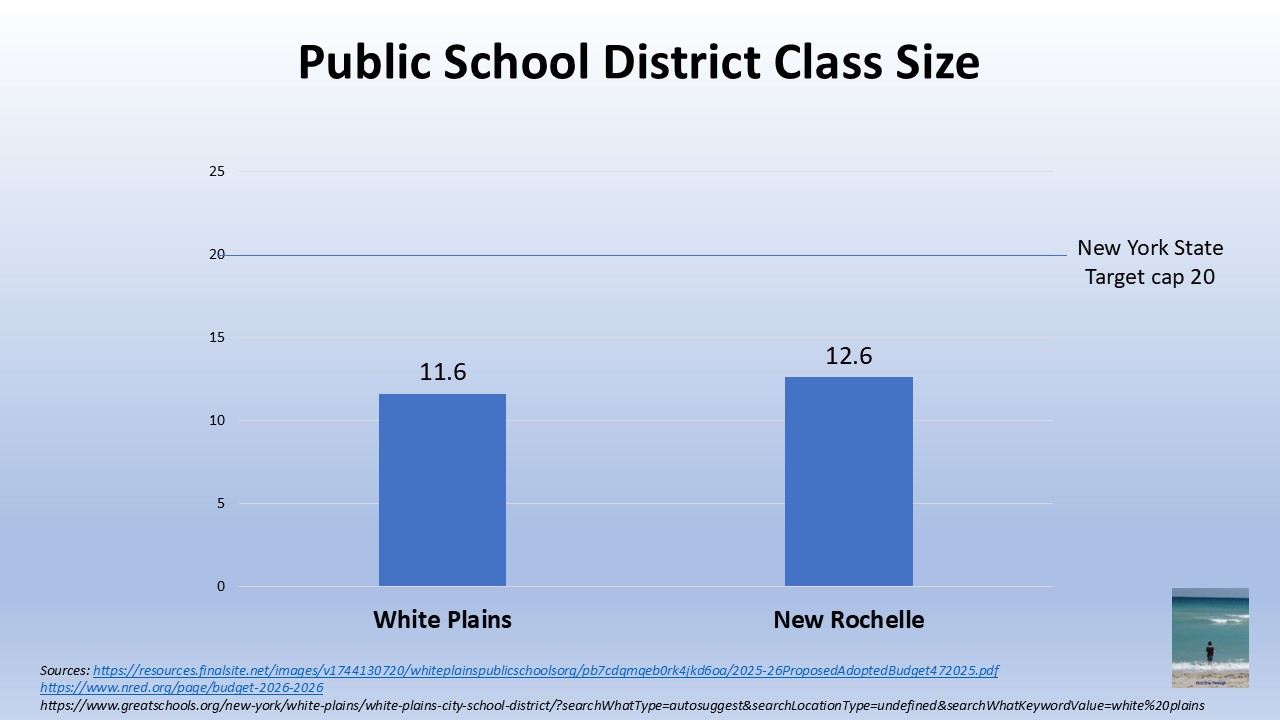
With 595 teachers, the WP student-to-teacher ratio was roughly 11.6:1, well below the stated goal of under 20-to-1. The overall WP district headcount including administrative positions was 1,196, or 5.7 students per school staff. This compares to NR with 767 teachers and 1,643 in total staff, or 12.6:1 student to teacher ratio and 5.9 students per staff.
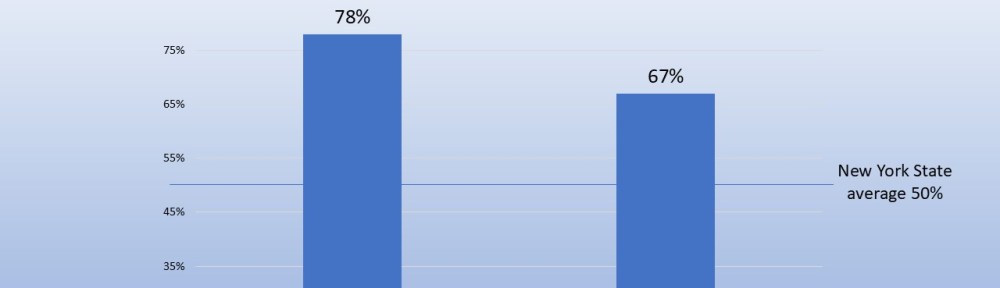
On average, school districts in the state are funded 50% by local taxes, 46% by state subsidies and 4% from the federal government. White Plains is 78% locally funded (74% property tax and 4% other taxes).
The actual WP budget submitted for approval shows a breakdown for the budget as: 50% for instruction, 25% for employee benefits, 15% for general support, 5% for student transportation, and 4% for debt service. Why is only half of a school budget going to education?
New Rochelle’s school budget is $360 million serving 9,700 students ($37,100 per student) and property taxes account for 67% of the budget. New Rochelle has a budget line for the high school principal of over $1 million and the department chair and supervisor each with $700,000.
Data Assessment
The data is not consistent between sources but overall, it seems that White Plains spends more for students than New Rochelle. The reasons seem to be a relatively higher number of teachers as well as costs for more upgraded facilities. Despite spending more, the results for Hispanics and Blacks are worse on test scores but better on regents and high school graduation rates (92% to 83%).

Other Students
A total of 1,132 students in White Plains do not attend public schools, or over 14% of the total. These students do not receive funding for education, food, transportation or tutoring services.
There are no charter schools in either White Plains or New Rochelle, making the public schools the sole recipients of all funding, despite one in seven students being educated outside of the schools.
WP School Board
The White Plains school board is made up of seven people, each serving a three year term. In 2025, two of the most tenured board members have terms coming up.
| Name | Assumed Office | Term Ends |
|---|---|---|
| Jessica Buck | 2024 | 2027 |
| Craig Mondschein | 2024 | 2027 |
| Cayne Letizia | 2015 | 2027 |
| Valerie Daniele | 2023 | 2026 |
| Rosemarie Eller | 2005 | 2026 |
| Sheryl Brady | 2007 | 2025 |
| Charlie Norris | 2007 | 2025 |
As seen in the table above, there are three people on the board who have been serving for almost two decades, and three people serving in their first terms. Ideally, a board should have a mix of current parents together with people with historic knowledge.
There are four people running for the two seats. Sheryl Brady and Charlie Norris are both seeking reelection. Newcomers Julia Oliva and Dr. Mohammed S Chowdhury are also seeking the board positions. They all submitted responses to a questionnaire submitted by the League Of Women Voters of White Plains, which will be hosting a forum on May 13 at 7:00pm at the WP High School.
I spoke to the four candidates about their interest in the school board. Below is a snapshot.
Sheryl Brady:
- She grew up in Westchester and is passionate about education and continues to keep up to date with seminars.
- She had four kids go through the public school system and was very involved in the PTA. She is also very involved in Kol Ami in addition to the public schools.
- She thinks the superintendent Dr. Joseph Ricca (Josephricca@wpcsd.k12.ny.us 914-422-2019) is fantastic and always available for questions. She believes he is also well known at the state level.
- Brady believes the school board is about setting tone and policy which is focused on the intrinsic value of every person.
- Her focus is on targeted, individualized instruction for the students.
- She thinks the school facilities are amazing and acknowledged the community support for a $60 million bond issue to fund the improvements to the schools and athletics fields.
- She is supportive of the cellphone bans in schools but likely would have been more permissive for high school students than the state mandate.
- She thinks the governor’s mandate on teaching gender identity in all grades including lower grades should be age appropriate
- She does not think antisemitism is a big issue in the district, and whenever there is an incident, to use it as an opportunity to bring the students together to learn empathy and Jewish history of persecution, and the Holocaust in particular.
- In regards to teaching about the Arab/Muslim-Israeli conflict, she thinks teachers should not take sides and try to maintain respect.
Charlie Norris:
- He grew up in Hartsdale and is passionate about education. His two children were fourth generation in WP public schools
- He was the first male head of the PTA in 1993 and that got him involved in the school and ultimately the board in 2006. He has seen the schools change to be much more Hispanic and pivot according to their needs as well as special needs students which are much more numerous now than when he was a parent of a student.
- He is very proud of where WP is now, while other schools in Mount Vernon and New Rochelle need to lay off teachers and cut programs.
- He loves the state-of-the-art facilities already constructed the last few years as well as the new $35 million building going up to expand the high school. It is going up without an increase in taxes.
- He is in favor of banning cellphones for kids in school.
- He is in favor of teaching gender identity in schools and all types of family structures in an age appropriate manner.
- He thinks antisemitism in schools is a function of general society and children pick it up (rather than it being introduced in schools). When there are incidents, they bring in rabbis to have meaningful discussions.
- For the Arab/Muslim-Israel Conflict, he thinks it is important to be informative without taking sides. It is for educators to choose materials for the students and only sometimes does that come up to the board level.
Julia Oliva:
- She moved to White Plains in 2007. She has one young child in the elementary school and a second one will enter in a year.
- She has gotten involved in the school because she felt there were issues not being addressed. The open mic at the school board sessions allowed her to have a one way discussion but never heard back from anyone.
- She is in favor of banning phones and wants teachers to be equipped with how to handle situation.
- She wants to see more vocational instruction in high school as many students are probably not situated for college. She wants courses to prepare students for jobs in technology and cybersecurity, as well as healthcare with the number of expanded medical facilities opening in White Plains.
- She thinks that too much money is being spent on non-essential capital projects rather than services. She thinks it’s a poor decision to drop some courses to have state of the art bleachers at the athletic fields.
Dr. Mohammed S Chowdhury:
- He has been a White Plains resident since 2002. He is a physician.
- He has not been involved in the school and was not knowledgeable about any of the metrics or issues mentioned above. His one son graduated from the school last year and he is seeking to volunteer now. He mentioned that he would tutor.
WP School Board Assessment
Sheryl Brady and Charlie Norris are pretty interchangeable. Both are liberals who have lots of institutional knowledge and having one of them is enough. Julia Oliva seemed very engaged but it is unclear how she would function in a committee setting. Dr. Chowdhury is ill-prepared to serve on the board with no involvement in education and no child at the school.
With 14% of the WP student body not attending public schools, I suggest someone with students in private school run for the school board next year. There are no monies going to compensate students at other schools for their transportation, tutoring or food which happens for the public schools. The 78% of the budget being borne by residents must get pushback from someone at the board and the two incumbents are unlikely to so.
The White Plains Teachers Association bargaining agreement ends in June 2026. It is important to have someone looking out for taxpayers on the school board.
Be involved in the budget process and get information at (914) 422-2071 or email budget@wpcsd.us. There is a Board of Education meeting on May 12 at 7:30 at the High School Auditorium and a League of Women Voters meet the candidates on May 13 at 7:00pm at the WP High School Library Media Center.
New Rochelle School Board
New Rochelle has a nine member board serving five year terms. Two spots are available in 2025 and five people are competing: Myriam Decime, Elana Jacob, Jessica Klein, Dr. Rosa Rivera-McCutchen, and Keith Singletary.
Jacob and Klein are both from the local Jewish community which is looking to continue to build on its grassroots activism which helped get rid of Congressman Jamaal Bowman in the 2024 Democratic primary. Rivera-McCutchen is closely aligned with Bowman and Decime is also part of the Black “progressive” movement. The school board election is a mini rematch of the heated NY16 congressional contest. Singletary is a CPA and focused on risk assessment and a much more reasonable choice than the other Black candidates as the NR public schools are in bad fiscal health.
The League of Women Voters will hold an in-person candidate forum on Monday, May 12, at 6 pm at City Hall and the New Rochelle Chapter of the NAACP will hold an online forum with the Board of Education candidates on Sunday, May 18, at 4 pm on Zoom (Meeting ID: 997 9688 1792, Passcode: 607622). To speak at a public hearing contact mbonilla@nredlearn.org, 914-576-4219.
Conclusion
White Plains: WP residents are paying an astronomical $40,000 per public school student, and are covering 78% of that cost – well in excess of the state average of 50% or New Rochelle’s 67%. The WP board budget presentation that “staff salaries are in line with collective bargaining agreements” and that the taxes are not as high as they could have been, is grossly misleading. The school board has been pouring money into professional quality facilities and an incredibly high number of teachers relative to the student population, while Black students are doing terribly in English, Hispanic students are doing poorly in science, and 14% of the students not in public school are getting nothing.
- Reject the budget to lower the budget by $3.4 million.
- Remove one of the long-serving board members with Julia Oliva to reorient the schools more to services than gold-plated facilities.
- A parent from the private school community should run in the 2026 election – all that’s needed is 100 signatures from within the district.
New Rochelle: The vast majority of the nine member school board is from the Black community which makes up 19% of the student body and overall population. It would be a terrible outcome to see members of the far-left get seats on the school board.
- Vote for Jacob and Klein to get proper representation and overall balance on the board.

 First One Through
Dumbing down the young people🤬Lucie Ramsey
Sent from Yahoo Mail for iPhone
LikeLike
Pingback: School Board Elections Are Like Rotten Tomatoes Documentaries—Unanimously Approved Because No One Watches | First One Through
Pingback: School Boards Are the New Battleground: Why the New York Jewish Community Must Vote on May 20 | First One Through
Pingback: Shadow of Recent School Board Election Hangs Over Call to Prayer at City Hall on June 18 - New RoAR News
The DSA is toxic and antisemitic. Anyone they endorse or are associated with will bring out strong opposition
LikeLike