
Surrealism did not invent the language of dreams and symbols; it applied the principles to art. For the Jewish people, that language had long been central: a civilization built on ritual, memory, and meaning encoded in objects, stories, and repeated acts of remembrance.
When Surrealism emerged from Freud’s ideas, it offered a new lens to examine what Jews had already lived: that symbols shape identity, and that dreams can carry a people across time. In the aftermath of Europe’s destruction, that lens reveals a stark contrast: while others turned to common stories to process loss, the Jewish people used their symbolic tradition to rebuild and to turn dream into reality.
Interpreting Dreams
At the turn of the twentieth century, Sigmund Freud (1856 Czechia – 1939 United Kingdom) proposed something radical: that the human mind operates on two planes at once. The conscious – ordered, rational, disciplined. And beneath it, the unconscious – restless, suppressed, filled with fears and desires that shape behavior without announcing themselves.
Dreams, Freud argued in The Interpretation of Dreams (1899), are the bridge between these worlds.
They are not noise. They are language.
A language built on symbols: recurring forms that carry meaning across individuals and cultures. A house becomes identity. Water becomes birth or transformation. Men are featured as long cylindrical objects while women are enclosed spaces. Objects are never just objects. They are carriers of something deeper, something shared.
Freud did not invent symbolic thinking. He revealed that we are already immersed in it.
And once that realization entered European culture, it transformed how artists saw their role: not as imitators of reality, but as revealers and interpreters of the unconscious.
The Dream Made Visible
Surrealism emerged from collapse.
World War I shattered Europe’s faith in reason. The same systems that promised progress delivered mechanized death. Logic, order, and scientific advancement had not restrained violence but refined it.
Into that rupture stepped André Breton (1896 France -1966 France). In 1924, his Surrealist Manifesto defined the art movement as “pure psychic automatism,” an attempt to express the true functioning of thought, unfiltered by reason or convention. It was a deliberate rejection of the structures that had failed and a search for truth in the raw, unmediated currents of the mind.
Surrealism was not escapism. It was rebellion against a reality that could no longer be trusted.
Artists like Giorgio de Chirico (1888 Greece – 1978 Italy) created haunting spaces – empty plazas, long shadows, objects placed together without explanation. These works do not resolve into meaning. They create a feeling of dislocation, of being suspended in a waking dream where logic loosens its grip.
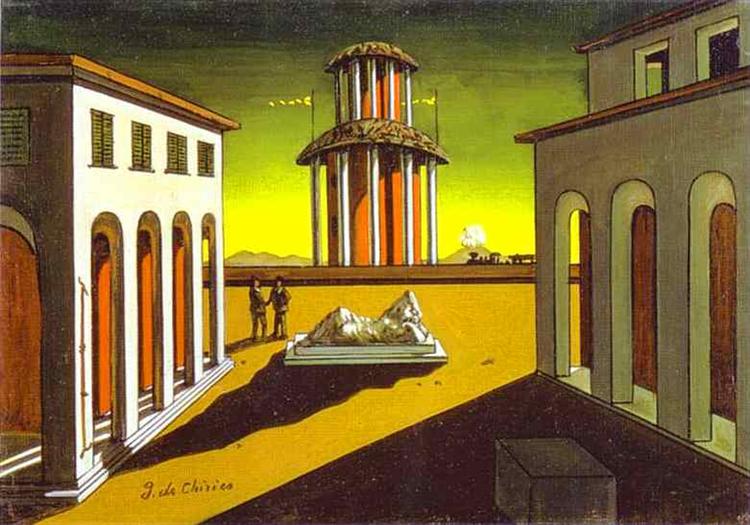
Jane Graverol (1905 Belgium – 1984 France) made the point plainly, saying that her canvases are “waking, conscious dreams.”
René Magritte (1898 Belgium – 1967 Belgium), strips away ambiguity and addresses the viewer directly. His 1929 painting The Treachery of Images confronted viewers with the bold statement “This is not a pipe” that what they were seeing was not an object but the symbol of an object.
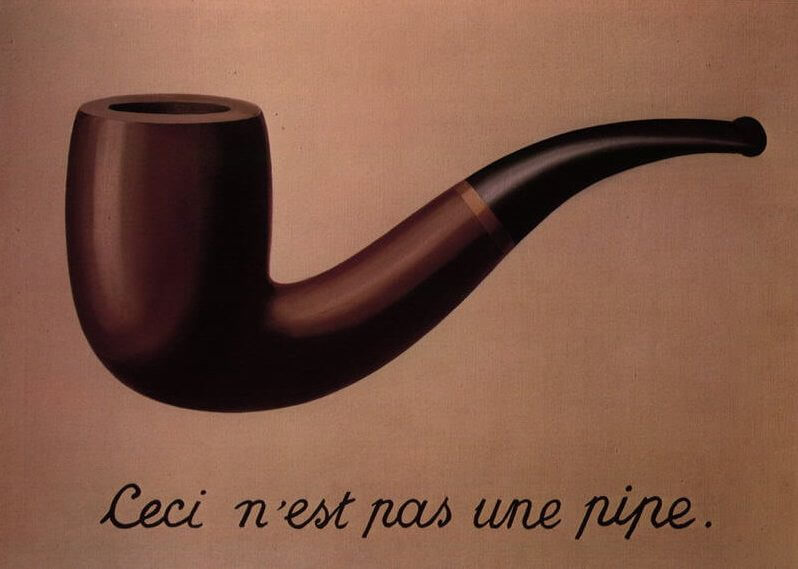
The statement is instructional.
Magritte is not playing with illusion. He is teaching a fundamental principle: that art is inherently symbolic. The painted pipe is not a pipe but a representation of a pipe. A constructed stand-in for reality. The viewer’s instinct is to collapse that distinction, to treat the symbol as the object itself. Magritte interrupts that instinct and forces recognition.
This is not just a lesson about art. It is a lesson about perception.
Before and After the Abyss
Then came World War II. And the question of perception became far more dangerous.
Before the war, Surrealism destabilized reality with intellectual daring. It exposed how fragile meaning could be, and how easily the mind imposed order where none existed. De Chirco expressed this when he said “although the dream is a very strange phenomenon and an inexplicable mystery, far more inexplicable is the mystery and aspect our minds confer on certain objects and aspects of life.”
After the war, the issue was not mystery. It was blindness.
The European Holocaust was not carried out by a primitive society. It was executed by one of the most intellectually advanced cultures in the world – Germany and Austria – lands of philosophy, music, and scientific achievement.
Civilization did not prevent barbarism. It coexisted with it.
And in that realization, Surrealism’s inquiry deepens.
Consider Magritte before and after the war.
In The False Mirror (1928), the eye is open—wide, consuming the sky. There is a sense of total perception, of a world fully visible, even overwhelming.
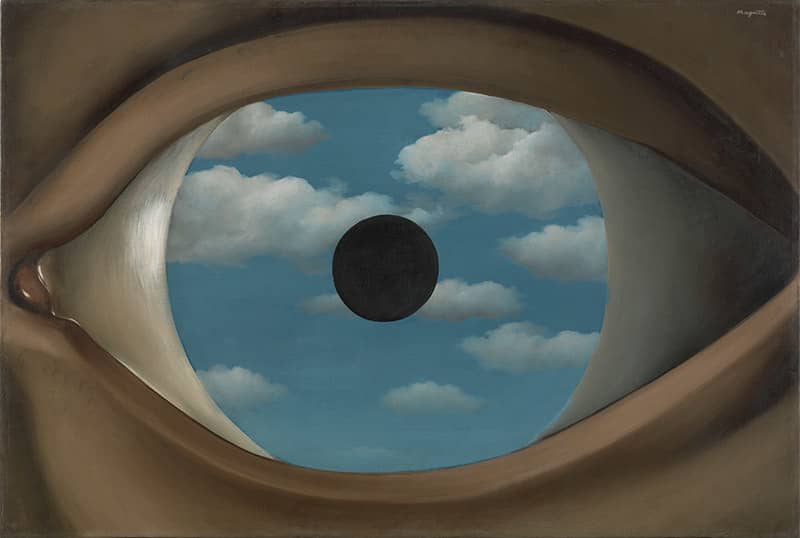
By 1964, in The Son of Man, the face is obscured by a green apple.
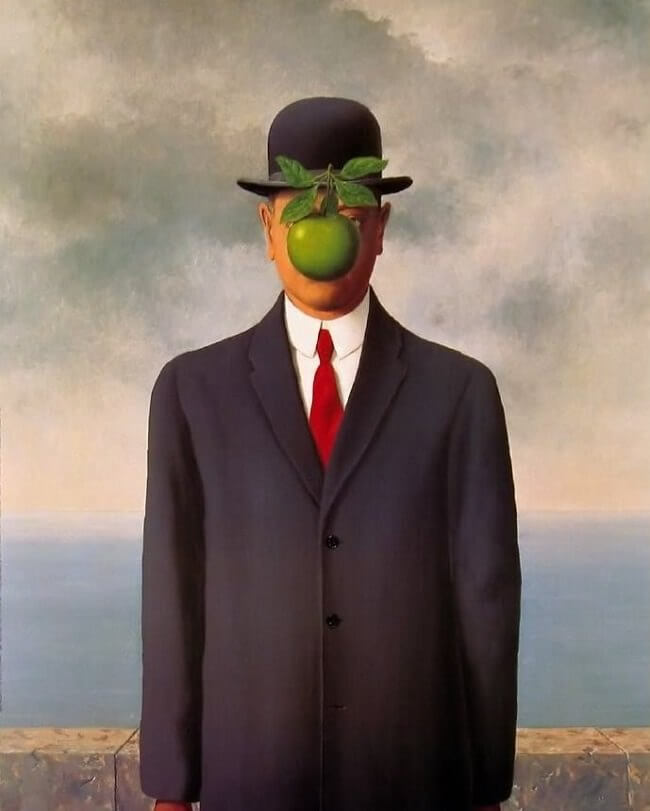
The shift is profound.
The apple is not arbitrary. It carries centuries of symbolic weight: knowledge, intellect, the pursuit of understanding. It evokes Eden, the awakening of consciousness, the belief that human reason elevates and refines. And simultaneously leads to destruction, despair and the loss of paradise.
Here, that very symbol blocks the face.
What if the world’s admiration for European intellect – its reverence for German philosophy, Austrian culture, scientific brilliance – functioned as a kind of blindness? What if our advances in science and knowledge was ultimately too much responsibility for our minds to handle and yielded ultimate weapons of mass destruction to end all life?
A society’s fixation on knowledge obscured the capacity for evil.
The world saw the body and the apple. It saw a society of culture, sophistication, refinement. It did not see the face – the person, the emotion, the intent – behind it. And that face? It saw nothing at all, blinded completely by knowledge.
Magritte’s post-war image reads as indictment of willful misperception. The failure was not that reality hid the truth. It was that humanity chose not to see it.
Myth as Reconstruction
In the aftermath of this rupture, some Surrealist artists turned to mythology, a common history and culture of a now divided Europe. Myth offered what history cannot: a structure to process loss.
Consider Orpheus.
He descends into the underworld to retrieve his lost wife, Eurydice, only to lose her forever when he looks back. The story is not about failure of effort; it is about the finality of loss.
Jane Graverol paints this in 1948, as a Belgian artist from a country invaded and devastated in a war it did not seek. As Europe begins to absorb the reality of the concentration camps – the industrial killing, the desecration of bodies – the imagery becomes unbearable.
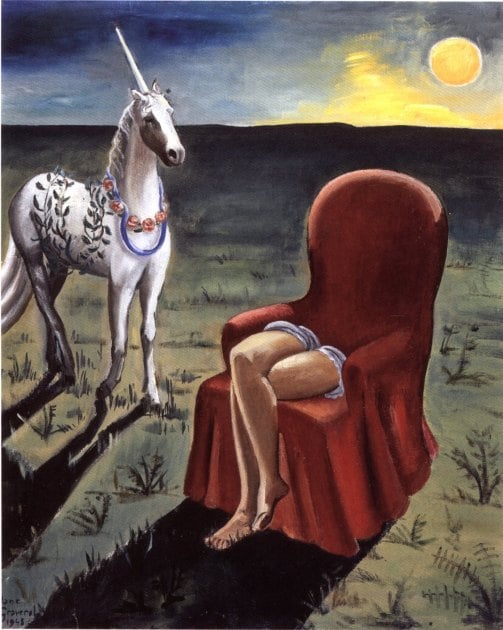
A woman fused into a chair – half human, half object – evokes not abstraction, but transformation of person into material. A world in which the boundary between human and furniture was grotesquely violated.
This is not simply Orpheus losing Eurydice, disappearing as they emerged from the underworld. It is Europe recognizing that what was lost cannot be restored.
Now consider Ulysses.
After the Trojan War, Ulysses (Odysseus) spends ten years trying to return home to Ithaca. His journey is long, disorienting, and filled with trials – temptation, destruction, loss of companions, divine obstacles. When he finally arrives, he is not recognized. His home has been overtaken. He must reclaim it, rebuild it, reassert his place within it.
Return is not restoration. It is confrontation.
Giorgio de Chirico captures this in The Return of Ulysses.
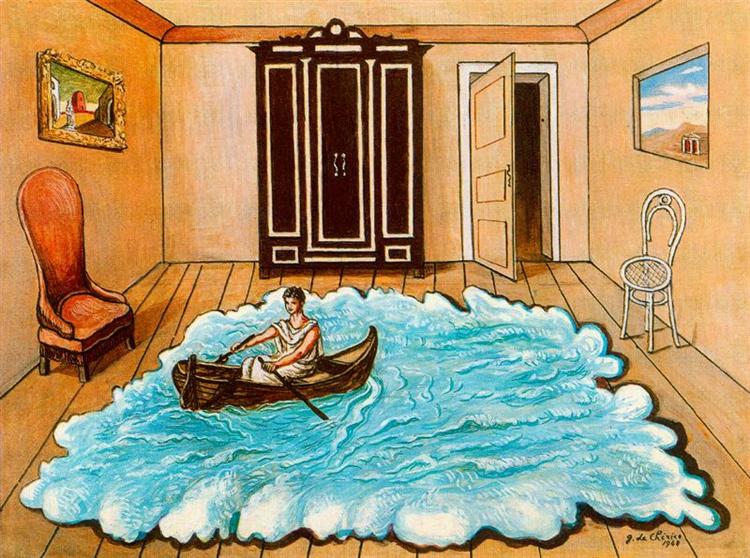
The painting is divided.
On the left, a framed work from decades earlier sits beneath a heavy red chair. It anchors the past.
On the right, a frail white chair sits beneath an open window – exposed, stripped, uncertain. The solidity and comfort of the past gives way to fragility.
And in between, Ulysses. Small. Reduced. Rowing across water inside a room forcing the viewer to confront the symbolism.
Water, the symbol of birth, of transition, of beginning again.
He is not standing in triumph. He is navigating between worlds—between what was and what might be.
And then, something unexpected. An open door.
Not the past. Not the fractured present. But a third path.
Ulysses rows toward it. The hero moves toward something new.
The artist, from a country aligned with Germany during the war, was not focused on loss but a chance for a new future within his homeland, inside the familiar surroundings of his room.
The Jewish Path: Beyond Myth
And yet, there is a story that does not fit neatly within this framework of the Surrealist artists of the Allies and Axis. Because the Jewish people after World War II were neither and both.
They were the decimated. A people shattered, displaced, nearly erased – and forced to ask how to return, where to return.
There was no home to reclaim in the way of Ulysses.
No possibility of retrieving what was lost, like Orpheus.
There was only one path forward. Rebirth, in a new land.
And in a way unparalleled in history, they achieved it.
The reestablishment of the State of Israel was not simply political. It was civilizational. A people dispersed for nearly two thousand years, speaking different languages, living across continents, reconstituted sovereignty in its ancestral land.
Here, myth gives way to reality.
In 1968, Salvador Dalí – the master of dream imagery – was commissioned to create a series of 25 watercolor paintings for the Hartford Museum to mark Israel’s 20th anniversary. The timing was not incidental. It came just one year after the Six-Day War, when Israel not only survived existential threat but reunited Jerusalem, returning Jews to their holiest sites in the Old City.
If Theodor Herzl declared, “If you will it, it is no dream,” then Surrealism—an art form built on dreams—became the perfect language to express that transformation.
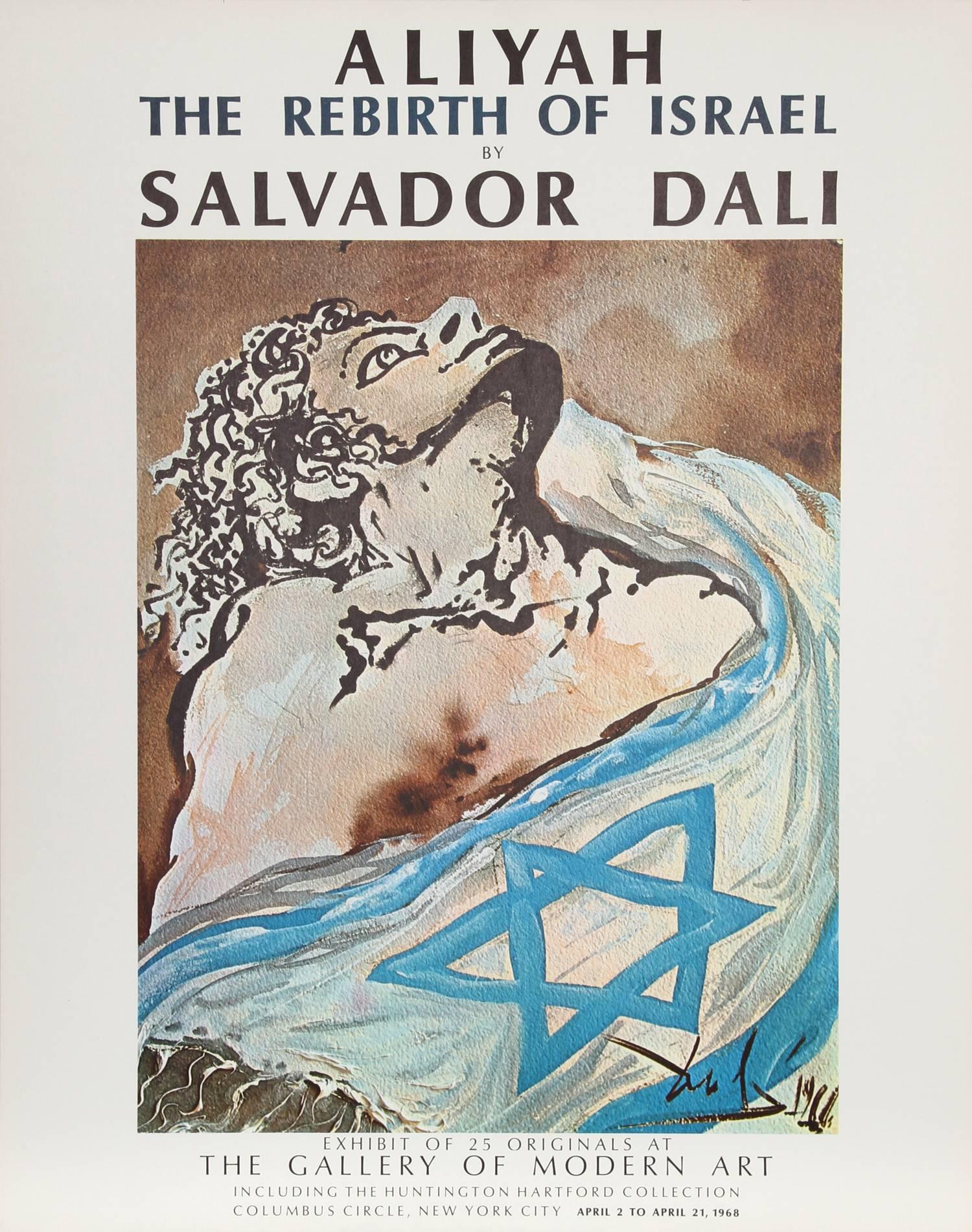
Dalí’s Aliyah: The Rebirth of Israel, the centerpiece of the series, captures this moment.
A figure rises, draped in the Israeli flag. And what is more symbolic than a national flag?
Two blue stripes evoking both the Mediterranean Sea and the Jordan River, the geographic bounds of the land, while simultaneously recalling the tallit, the Jewish prayer shawl. Nationhood and spirituality fused into a single image.
The figure is not merely standing. He is emerging naked and staring at the heavens.
This is not return. This is creation.
The Arc of Surrealism
Surrealism begins as an education, an attempt to translate Sigmund Freud’s insight into visual form, to show that human beings do not simply see the world, but interpret it through symbols, through dreams, through layers of meaning that sit beneath the surface. It teaches the viewer to slow down, to recognize that an image is not the thing itself, that representation is constructed, that what feels obvious may be anything but.
At its inception, it is a project of illumination, shaped by a Europe that still believed in its own intellectual coherence. From Paris to Brussels to Rome, it carries the confidence of a continent trying to understand itself through deeper, more elusive truths.
But that confidence does not survive World War II.
When Europe fractures, Surrealism fractures with it. The symbolic language remains intact, but it begins to tell different stories depending on where it is spoken.
In Belgium, through Jane Graverol, myth becomes a language of irreversible loss. The world she paints is one in which the human can be reduced to object, where dignity can be stripped away, where what has been taken cannot be restored. The symbols haunt.
In Italy, through Giorgio de Chirico, the question shifts. It is no longer about loss alone, but about return—about what it means to come home when home itself has changed. The past lingers, heavy and inescapable, while the future appears fragile, uncertain, barely formed. And yet, within that uncertainty, there is movement—a quiet insistence on choosing a path forward, even when the destination is unclear.
And then there are the Jews.
Not aligned with either side of Europe’s divide, but decimated, displaced, and exposed. They are not asking how to interpret what has been lost, or how to return to what was. Those paths are closed to them.
They are asking whether anything can be built again at all.
And it is here that Surrealism, for all its depth, turns to the Jews for answers.
Because the Jewish people did not need to be taught how symbols work. They had lived within that framework for centuries—through ritual, through memory, through stories that transformed objects into meaning and meaning into continuity. What Surrealism sought to uncover as theory had already been sustained as practice.
The Passover seder has been educating Jewish children for three thousand years about symbols, about the birth of a nation, and about the dream of Jerusalem.
Surrealism’s arc from the 1920s to 1960s was a story of Europeans wrestling with the mind and meaning before and after the war. It ends when those long familiar with symbolism left their nightmare and made their dream a reality.

 First One Through
Pingback: Von Träumen zu nationaler Identität: Surrealismus und die Wiedergeburt Israels | abseits vom mainstream - heplev