
The weekly parshas read from the Torah normally begin at the start of a chapter and conclude at the end of another chapter. It is extremely rare for any parsha to both start and end in the middle of chapters, which happens for the weekly reading of Vayetze (Genesis 28:10 – 32:3).
The reason for doing so has very much to do with the story told in Vayetze, as well as the stories which the rabbis wanted to separate at the start of Genesis chapter 28:1-9 in Parshat Toldot, and the story told afterward in Parshat Vayishlach, chapter 32:4-33.
Vayetze relays the story of Jacob leaving the land of Canaan to find a wife at Lavan, his mother’s brother’s house. When embarking, Jacob dreamt of a ladder going to the heavens with angels going up and coming down. God informed Jacob that he will be blessed with many children and that God would protect Jacob on his journey and bring him safely back to his land. At the end of the parsha, Jacob headed back to the land of Canaan with wives and eleven children, and met angels once again (Genesis 32:2-3). Angels are bookends of Vayetze, telling the story of Jacob marrying, and having many children and accumulating much cattle in his uncle’s house.
If one were to read Genesis straight through the chapters instead of with the breaks of the weekly portions, that story is less clear.
At the beginning of Genesis chapter 28 (1-5), Isaac instructed Jacob to not marry a local woman from Canaan and to visit his uncle’s house, seemingly consistent with the overall theme of Vayetze. However, 28:6-9 describes Esav’s overhearing Isaac’s command who subsequently embarked to marry his father’s brother’s daughter. Esav’s actions interrupted the focus on Jacob.
At the end of the parsha, the narrative also breaks around Esav. While Vayetze’s Genesis 32:2-3 has Jacob encountering angels and naming the location due to the holiness of the event as he did after his ladder dream, Vayishlach’s Genesis 32:4-7 has Jacob sending the angels off as mere messengers to scout out Esav’s intentions as he journeyed to return to Canaan. In one sentence, from 32:3 to 32:4, Jacob treated the malachim as holy people and then errand boys, which does not happen with the weekly parsha pause separating the sentences.
The neat angel bookends of Vayetze act as separators from Esav. While Jacob got married and returned with eleven children and a large flock, the difficult years were none-the-less realized as blessings. However, the stress of the world he left and to which he returned made the blessings harder to recognize, and maybe even finite.
Esav married Ishmael’s daughter and came to meet Jacob with an army of 400 men (32:7). While Jacob had been promised by God that his progeny would be numerous as he left Canaan, his brother Esav seemed to become even greater over that same time.
Upon learning of the large gap in power with his brother, Jacob became very frightened and prayed to God (32:8-13) seemingly thinking that his heavenly protection had ended. When Jacob next sends out messengers to meet Esav, they are no longer described as malachim, angels, but avadim, servants (32:17).
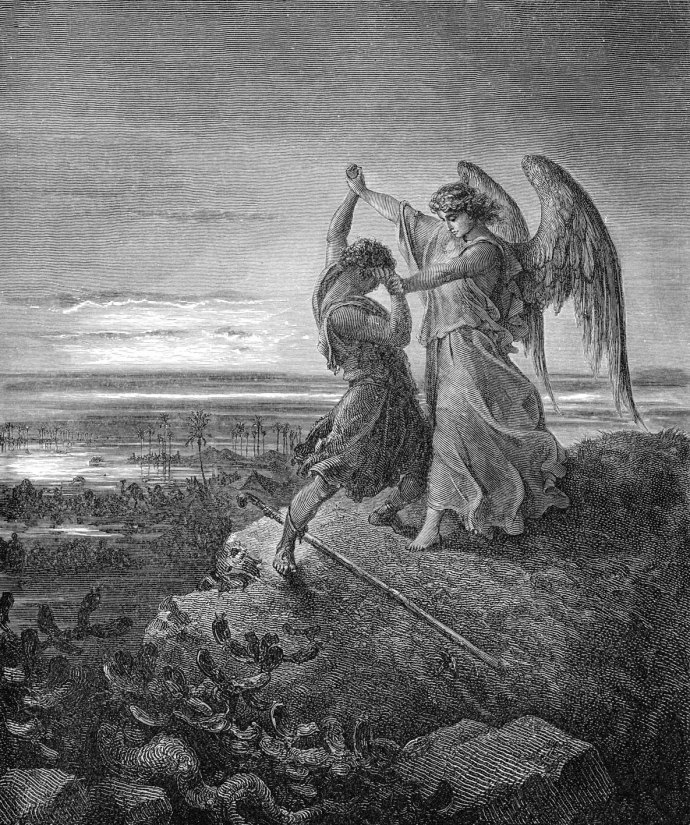
Jacob lost the ability to recognize angels as he approached his brother. When Jacob was next alone at night, he didn’t dream of angels on a ladder but wrestled with an ish, a man who is described by biblical commentators as an angel who renamed Jacob ‘Israel’ for prevailing in his fight with man and God. While Jacob should not have been scared of Esav as he had angels with him, he could no longer recognize them and fought them.
Jews today see their homes like Jacob as Vayetze Jews. Even in the face of family difficulties, a home is nevertheless a sanctuary in which we count our blessings and feel protected. It is when we compare ourselves to others and see their wealth and fear what they might do to us that we forget those blessings. We no longer see the angels and blessings they provide. So we demand that they serve our needs, and fight them thinking that they are strangers meant to do us harm.
And then we question the blessings we once enjoyed. Esav had no angels and yet prospered even more than Jacob. An unblessed life seemingly yielded greater rewards if one focuses purely on numbers.
Jacob produced a family which became a holy nation while Esav’s actions netted a massive army. During peace, it is easy to understand why Jacob’s descendants reach heights of thought and purity but in times of conflict, Esav’s army appears ready to conquer those achievements.
In a pre-October 7 world, Vayetze Jews imagined themselves blessed and protected in their home of homes, in their houses in Israel. The neat angel bookends of the parsha were the protective layer of building a home and family, and Vayetze Jews felt God’s blessings.
In the aftermath of the October 7 slaughter in which Arabs killed Jews in their homes in Israel, the Vayetze Jews were vanquished. We became Vayishlach Jews ready to fight man and God for the inhumanity inflicted on us.
Is that our fate? Can the Jewish community become more?
Jews must internalize the text in the chapters and not just the parshas.
Esav DOES interfere with the story-telling of Jacob finding a wife. Esav does continue to build a family and army outside of Jacob’s Vayetze bubble. Jacob and the Vayetze Jew fail to internalize the outside world as they were self-absorbed which led to complacency. Jacob only saw angels’ blessings as partners for his activities in his home but did not use the gift for the fight to come outside.
We are both the Children of Jacob (Vayetze Jews) and the Children of Israel (Vayishlach Jews), and need to live lives focused internally and externally. Partnering with angels must extend beyond the bounds of angelic bookends and touch activities in everything we do. That is the pathway to true blessing and success inside and outside of our home and communities.
Related articles:
The First Dreamer Foreshadowed The Life Of Joseph
The Karma of the Children of Israel
The Place and People for the Bible
The Shrinking Modern Jewish Homeland

 First One Through
Pingback: Jacob – And Esau’s – Ladder | First One Through